01/08/2023
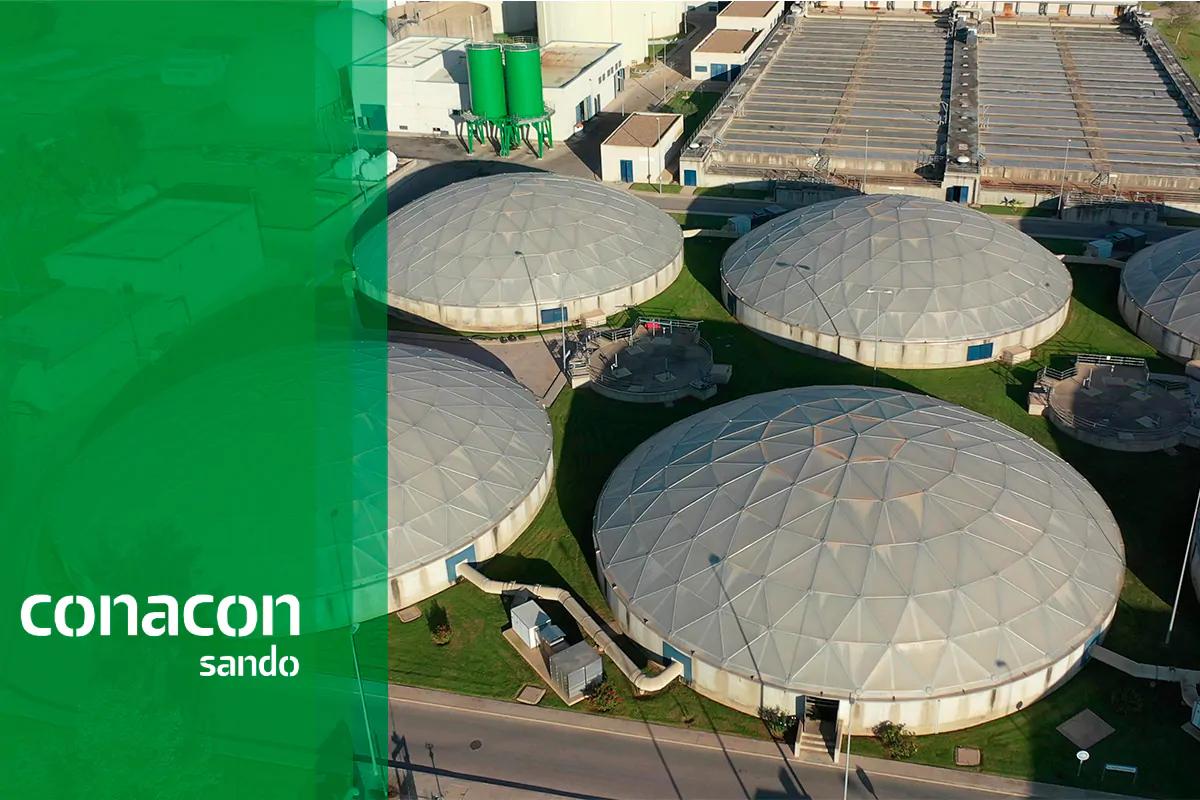
The Malaga-based company Conacon Sando (part of the Sando group) is developing a feasibility study from its Energy Department, co-financed by CTA (Technological Corporation of Andalusia) and in which the University of Malaga (UMA) and Sando Agua are participating, to analyse the opportunities for producing renewable hydrogen from Waste Water Treatment Plants (WWTP). The aim is to turn these stations into biofactories that generate renewable energy for other sectors. This project contributes to both energy efficiency and the circular economy, as it would allow waste from other activities.
Conacon Sando’s general manager, Jorge Gámiz Pérez, states, “We seek to convert a WWTP into a bio-factory with the capacity to respond to the challenges of the circular economy and energy efficiency using ‘green’ hydrogen. Once the biogas is obtained, its use in power and heat generation and its upgrading to separate two streams, biomethane and bioCO2, will be assessed”.
Carlos García, technical manager of CTA’s Building and Civil Works sector, explains that “the ENBIO project represents a paradigm shift in the vision and management of Waste Water Treatment Plants (WWTP). These will now be seen as new centres producing and distributing renewable energies rather than waste treatment points.
The optimisation of the processes for obtaining biogas from sewage sludge and its enrichment with renewable hydrogen from photovoltaic electrolysis, foreseen in the project, will enable significantly increasing and improving the production of high-energy gaseous biofuels for use in transport, industry and households, without restricting their use, as at present, to self-consumption at the WWTP.
The research group RNM 281 Grupo de Ingeniería e Investigación Ambiental (GIGA) of the University of Malaga (UMA) is participating in the project, achieving the transfer of knowledge from the scientific-university sphere to business activity.
The main objective of this study is to evaluate the capacity of biogas obtained in the anaerobic digestion process of sewage sludge from a wastewater treatment plant (WWTP) to generate biomethane. This study uses oxidation with renewable oxygen obtained through electrolysis, its potential as a source of renewable hydrogen production.
This Technical Feasibility Study (TFS) aims to assess the capacity of WWTPs to be transformed into energy and green product generation facilities through biogas production. With this objective in mind, evaluating the feasibility of implementation in WWTPs will take the La Ranilla WWTP in Seville as a reference facility.
A future research project associated with this EVT will contribute to improving the energy efficiency of the WWTP by obtaining biomethane and renewable hydrogen that can be used as energy vectors or raw materials and also to improving energy efficiency through the oxygen obtained in the electrolysis process in two ways: by analysing, on the one hand, its possible use in the combustion of biomethane and, on the other, its injection into the aeration line of the purification process, which would foreseeably significantly reduce its energy needs.
The ENBIO project should be a starting point for complementary research aimed at turning a WWTP into a biofactory with the capacity to respond to the challenges of the circular economy through the management of waste from other activities (of particular interest in the agri-food sector) and energy efficiency. In this case, not only because it is an energy-self-sufficient process but also because its net energy balance makes it a source of renewable energy.
Conacon Sando is Sando’s specialist in sustainable infrastructure and energy conservation. Committed to the environment, it maintains and optimises services for citizens by providing a quality experience and continuous innovation. The Sando Group is a multinational company dedicated to constructing sustainable infrastructures and managing services. Highly committed to the environment and innovation, it carries out works and manages services for its clients that preserve the environment and improve people’s quality of life. It has always based its strategy on diversification, both geographically and in terms of business. It has maintained a solid commitment to technological innovation and social responsibility.
Sando has been a member of CTA since its foundation and has developed a multitude of R&D&I projects financed by this Foundation, carried out both directly by the construction group and by some of its subsidiaries, which have made it a technological benchmark in its sector and helped it to become more competitive.
CTA is a private foundation with more than 170 member companies and almost 18 years of experience, initially promoted by the Andalusian Regional Government, privately managed and dedicated to promoting regional R&D&I and technology transfer.
CTA is a cluster that helps companies plan an innovation strategy, from identifying their R&D&I needs to formulating projects to solve them or searching for partners and the necessary funding to carry them out. In addition, it has deployed a series of services to help companies, universities, technology centres, government, and other entities transform the results achieved into wealth and business. It is also increasingly active internationally. It has participated in more than 45 EU and multilateral-funded international projects. It has collaborated with more than 300 organisations in 35 countries.
Don’t miss anything.