02/02/2026
On Monday, February 2, the ceremony of laying the first stone of the new hospital in Malaga, called Virgen de la Esperanza, took place. A project promoted by the Junta de Andalucía, which will be carried out by the Temporary Joint Venture (UTE) made up of OHLA, Sando Construcción and Vialterra and which will become one of the most important health infrastructures in the country.
The event was attended by the president of the Junta de Andalucía, Juan Manuel Moreno, as well as the Minister of Health, Presidency and Emergencies, Antonio Sanz; the Minister of Economy, Finance and European Funds, Carolina España; the mayor of Malaga, Francisco de la Torre, and the president of the Provincial Council, Francisco Salado, along with other regional and local authorities.
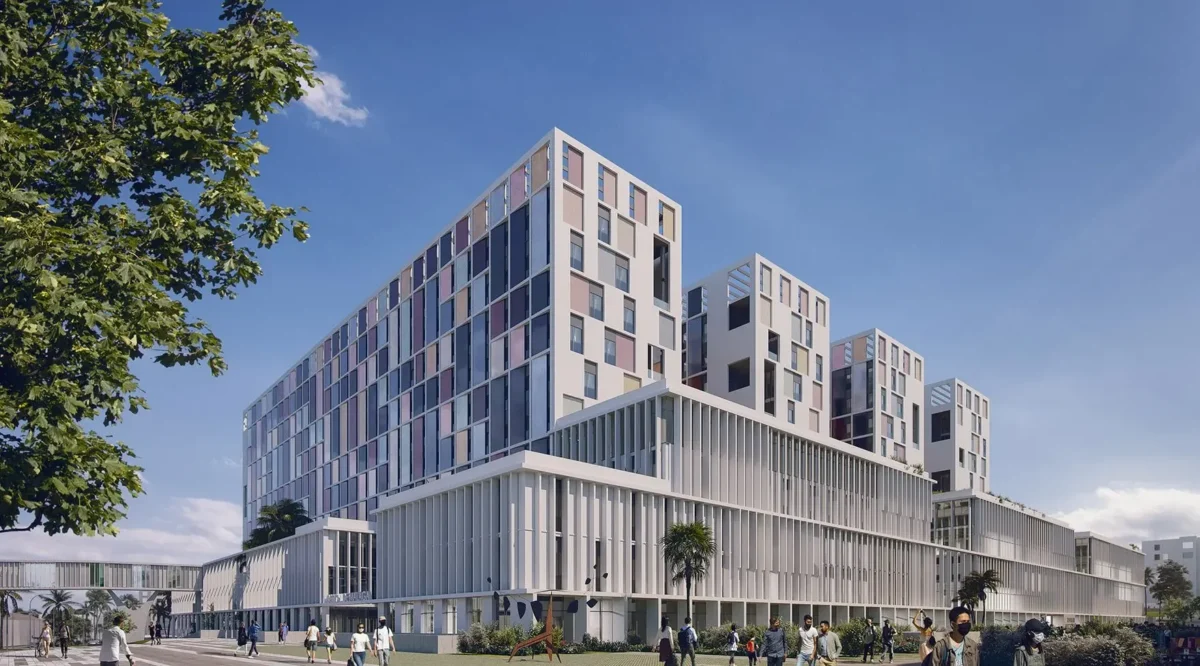
The president of the Junta stressed during the event that the new hospital will be the largest civil work to be carried out in Spain: “A complex that will be spectacular for its size, its design and its innovative character. It will be a hospital machine of precision and efficiency, as the experts describe it.”
The new hospital complex to be built by the Sando-OHLA-Vialterra joint venture will be built on the land of the current Civil Hospital and will be a key milestone for the reinforcement of health care in the region, as well as for the modernization of healthcare services. The action has a budget of 543.36 million euros (449.06 million excluding VAT) for the construction of the new hospital, the concession of the works and operation of the car parks and is co-financed by the European Regional Development Fund (ERDF), within the framework 2021-2027.
The future hospital will have 815 rooms, an emergency area equipped with 31 medical consultations, 8 nursing and 61 observation beds, as well as 80 ICU beds and a surgical block with 48 operating rooms. Likewise, the outpatient area will have 158 rooms for medical specialties and 38 for nursing, along with specific spaces for teaching and research. All this under a design conceived from criteria of humanization, accessibility and comfort, in which the use of new technologies and industrialization in construction will be a differential aspect.
The project will be developed in two phases. The first contemplates the construction of the car parks, while the second will focus on the construction of the hospital.
Don’t miss anything.